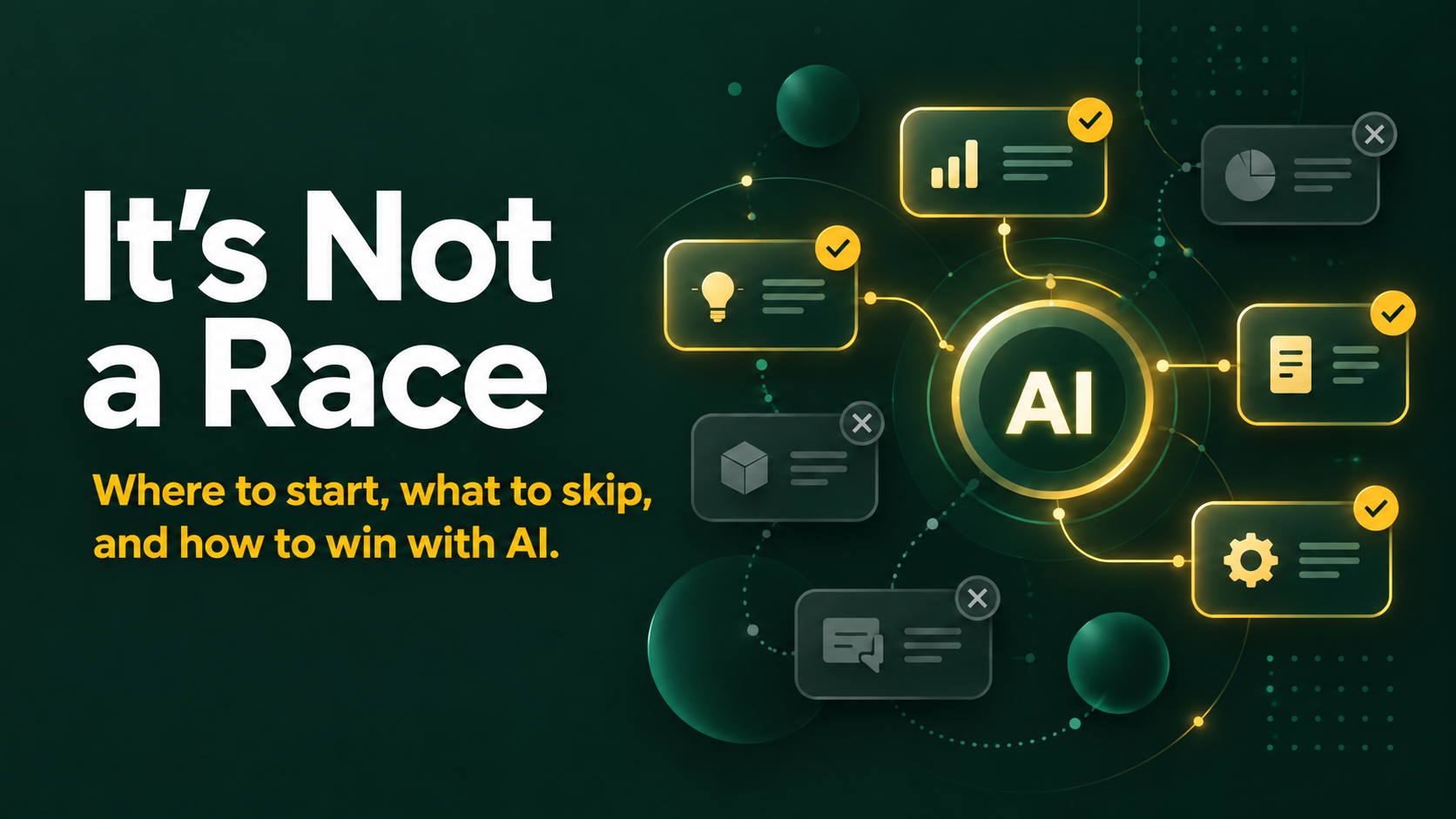
Everyone is telling small business owners to hurry up with AI.
If you feel overwhelmed because you haven’t started, or because you’re buried in tools that aren’t paying off, this course helps you develop the mental models and the skills you need to build a roadmap you can follow to real ROI.
| 10 self-paced modules, 2 live sessions | $649 with a money back guarantee* |
Why this exists
Free content teaches tools. They rarely teach judgment.
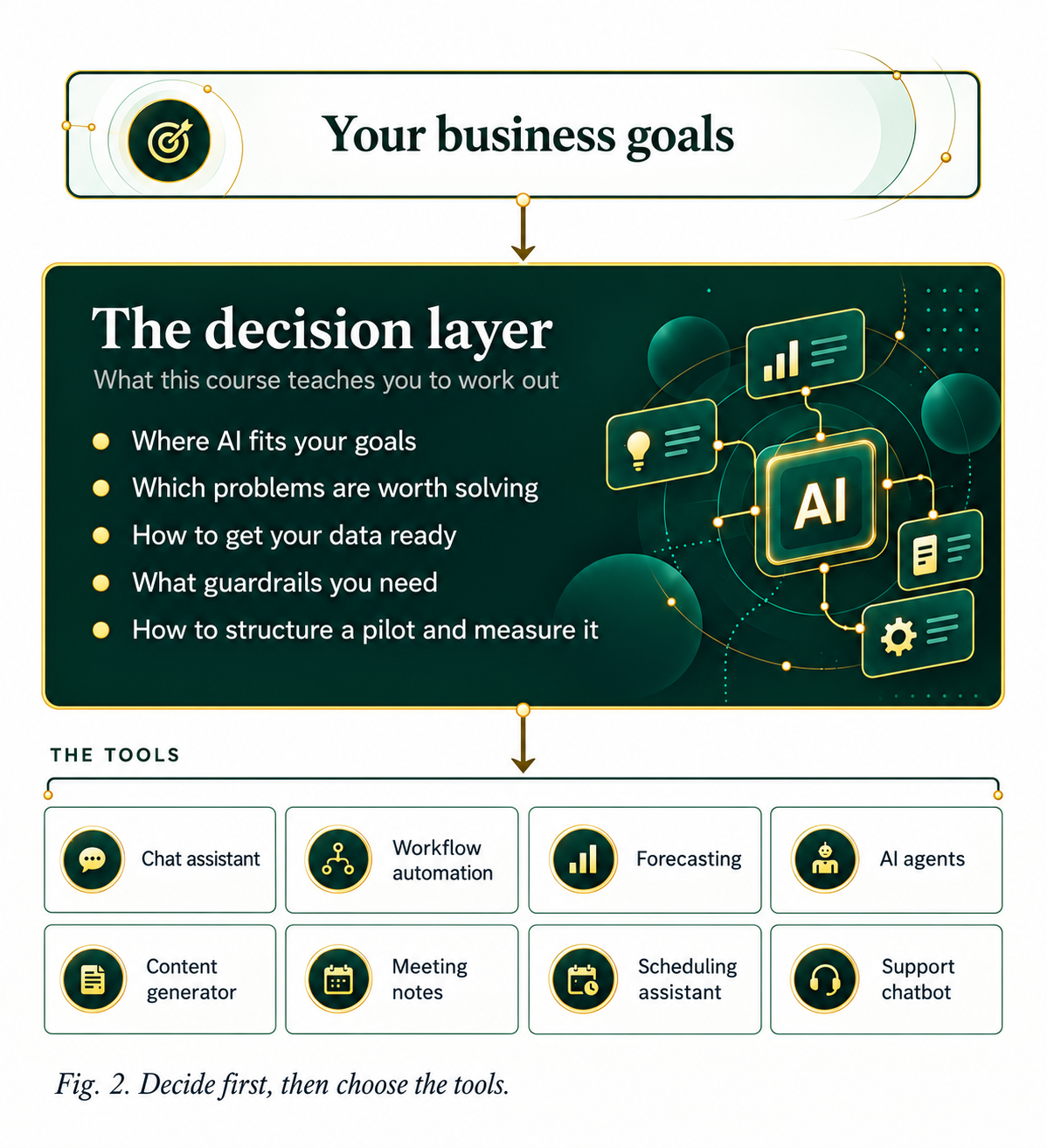
There is no shortage of free material on how to use ChatGPT, Claude, or Gemini. There also an overabundance or content demonstrating how to use various tools to automate workflows. What’s missing is the layer above the tool: how to find your own use cases instead of borrowing someone else’s, how to tell whether your data is ready for the opportunity you have in mind, how to read a vendor’s data-use clause, how to plan a rollout so it doesn’t turn into five disconnected tools by next year, and how to get your team to use what you’ve chosen.
This course comes out of hand-on AI work and a background in risk management, which is why it covers not only how AI projects succeed but also how they fail. Other businesses’ failures are far cheaper to study than your own.
Don’t waste any more time or money.
November 15, 2026, class is in session.
Secure your seat now.
This course is perfect for you if:
- You own or run a business and you’re the one who has to make the AI decisions
- You feel overwhelmed by AI, whether you haven’t started or you’ve tried a few things
- You want a clear plan you and a way of thinking about AI that you can apply to every decision that comes next, not simply another tutorial
Curriculum
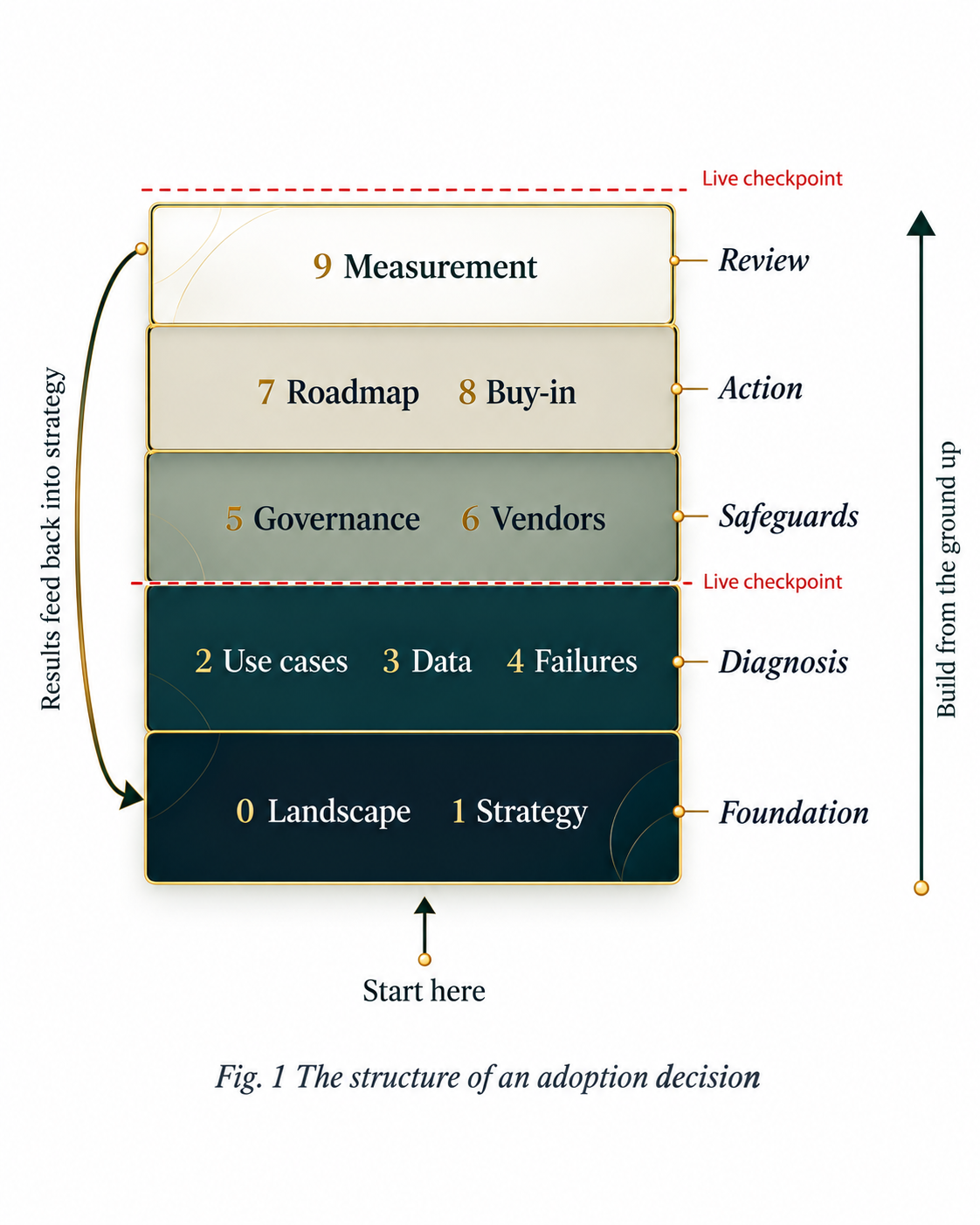
Ten modules, roughly 10 hours, plus two live checkpoints
The main families of technology sold under the AI label, from rules-based automation and predictive models to generative AI and agents, and what each is good for. Then the automation spectrum, from tools that assist a person to systems that act on their own, and where human judgment belongs along it. This is the vocabulary you’ll use to size up your own use cases and every tool you evaluate afterward.
Before looking for use cases, decide what AI is supposed to do for your business. This module ties adoption to your business goals, defines how much risk you’re willing to take on, assesses your company’s capacity to absorb change, and identifies the conditions under which the right answer is to wait. The result is a short strategic frame that tells you which opportunities are worth pursuing and which are just efficient distractions.
How to look at your own operation the way an outside advisor would: tracing where time, money, and errors accumulate, separating the symptom people complain about from the process causing it, and testing each opportunity against the strategic frame you set in Module 1. You come out with a prioritized set of use cases grounded in how your business works.
Every AI use case runs on data, and most stall because the data isn’t where, what, or as clean as everyone assumed. This module covers how to find out where your data lives, whether it’s complete, consistent, and accessible enough to support the use cases you’ve identified, who owns it, and what it would take to close the gaps. You’ll sort your candidates into what’s viable now and what needs groundwork first.
Real AI failures, from chatbots that made promises their companies had to honor to hiring software that screened out qualified applicants, alongside the failures most common in small businesses: tools nobody uses, pilots that never scale, and subscriptions that don’t connect. Each case is traced to the decision that could have prevented it. You finish learning how to conduct a pre-mortem on your own top use case, working out the most likely ways it could fail before you commit to it.
A live session at the course midpoint. We walk through a realistic small business’s strategy, use cases, and data gaps using the frameworks from Modules 1 through 4, then open the floor for questions.
What data can touch which kind of AI tool and how to read a vendor’s data-use terms, plus who’s accountable when an output is wrong, when a human has to review something before it reaches a customer, how to spot inequitable outcomes in an AI-assisted decision, and who owns what the tool generates.
A scoring rubric that separates real capability from a well-run demo, plus the questions a sales call is built to dodge.
Take your strongest candidate from Modules 2 and 3 and scope it as a real pilot: owner, timeline, success criteria, and the conditions under which you’d stop it. Then build a roadmap around it, whether you’re starting fresh or pulling existing tools and experiments into a plan that finally connects them.
How to bring skeptical staff, partners, or investors along: explaining why you’re making the change, addressing concerns about jobs and quality, and training people so what you’ve chosen gets used.
The difference between adoption metrics and outcome metrics, how to read your pilot’s results against the criteria you set in Module 7, and a lightweight way to decide whether to scale, adjust, or shut it down.
A closing live session. The same example from the previous live session is carried through governance, vendor selection, roadmap, team buy-in, and measurement, followed by open Q&A on anything from the full course. Volunteers can bring their own pilot plan or roadmap for discussion.

Your Instructor
Ivy Walker
I know what it feels like to run a business when you’re short on time and short on resources. Everything feels like a heavy lift. You’ve got great ideas and want grow your business, but you’re kind of stuck in place. You spend your time dealing with all the things you have to get done and that’s preventing you from getting to all the things you want to do. This is where the power of leveraging technology properly comes in.
In my career, I’ve run multiple companies across different industries, I’ve coached hundreds of business owners and I’ve taught more than a thousand entrepreneurs in live courses on various operational, risk, and technology topics. I’ve seen a lot done right and even more done wrong. And when it comes to AI, I’m seeing a lot of people making the same mistakes they’ve made before. What feels so different to me about what I’m seeing this time is that the stakes are higher. That’s why I created this course.
You’ll learn practical skills that you can immediately put to use in your business. Immediately. I’m so sure you’ll benefit that if after taking the first three modules, you don’t feel this course is right for you, I’ll refund your money. No. Questions. Asked.
Want to know a bit more about my background? Here’s a brief summary. You can also check out my LinkedIn and my personal website for more information.
- Serial entrepreneur in the ethics, staffing and AI industries
- Experience in Fortune 500 consulting and investment banking, venture-backed digital health startup, private equity and nonprofit sectors
- AI and risk management expert
- Award winning author and documentary filmmaker
- Adjunct faculty at Northwestern University Kellogg School of Management Executive Education, teaching AI strategy and risk management
- Certified in No Code AI and ML through MIT Professional Education

Enroll Today!
Course starts on November 15th.
Because this course includes live sessions, seats are limited.
10 self-paced modules, 10+ hours of content
2 live checkpoints with learning recap and open Q&A
Eight downloadable frameworks and tools
$649
Course starts Nov 15th
Seats are limited. Money back guarantee.*
*Work through Modules 0 to 2 and if you haven’t found value by the time you’ve identified your our use cases, request a refund before starting Module 3.
Frequently Asked Questions
Do I need a technical background?
No. Module 0 lays out the technologies and the automation spectrum in plain language, and nothing after it assumes coding or other technical experience.
I already use AI tool every day. Is this still useful?
Yes, this course is about developing a management and decision-layer skill set, not any one particular skill. This is what you need to build a credible AI roadmap that yields a meaningful ROI. If you only want tool tutorials, this isn’t that. There are plenty of free YouTube tutorials for that.
What happens in the live checkpoints?
Each one pulls together what you’ve covered to that point through an example of a business applying what was learned, then opens for Q&A. You’ll need to complete the modules that precede the checkpoint to get the most out of it. For those unable to attend live, both checkpoints are recorded.
What if this course isn’t right for me?
You can request a full refund any time before you start Module 3. By then you’ll have worked through the AI landscape, set your strategy, and identified your own use cases, which is enough to know whether the rest of the course will pay off for you. You must complete Module 0, Module 1, and Module 2 to qualify for a refund.